
How well we disperse and administer a COVID-19 vaccine will have enormous health, social and economic implications. Attention is turning to vaccine supply chains and logistics.
Creating how finest to immunize billions of individuals worldwide is complex. This is particularly so for large nations, such as Australia, where dispersing vaccine to rural and remote areas is required.
Despite numerous past pandemics and epidemics, extremely couple of studies worldwide have tackled the problem of developing and developing an effective vaccine circulation network. Existing research studies have likewise not completely considered all elements impacting vaccine distribution.
So our team designed a mathematical design to test different scenarios for COVID-19 vaccine circulation, which we have actually submitted for publication.
What we considered
Our model took a look at different ways to disperse COVID vaccine to 6.9 million Victorians, based upon the variety of citizens predicted in 2021
We modelled this using circulation through the state’s 325 medical centres, which can be everything from big city medical facilities to small medical centres in local locations.
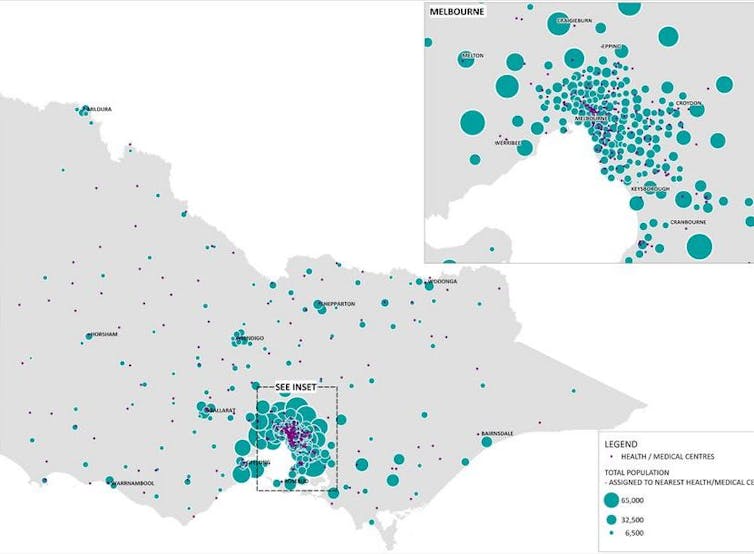
We presumed most vaccine distribution would be by roadway and sufficient refrigerated vehicles would be readily available.
We also factored into our design that particular sections of the community are at increased risk of direct exposure (for example, city dwellers) and others are more vulnerable to infection (for example, aged-care locals and health-care workers). These individuals are not evenly dispersed around the state, affecting vaccine circulation logistics.
We then tested various situations to see for how long vaccination would take.
Our research study reveals we need 3 essential aspects for success.
1. Medical centres require to be big enough
We determined that if the capability of the 325 medical centres is big enough, and if enough vaccine is available, the whole population of Victoria can be vaccinated within 60 days.
By capacity we mean the maximum variety of vaccine doses each medical centre can administer. And this capability depends upon a range of factors consisting of centres’ physical size, and having enough staff to administer vaccines.
This time frame or “target horizon” is the overall number of days to vaccinate the population of Victoria. Although we have actually calculated this is possible within 60 days, the state or federal government will really set this target.
To vaccinate all Victorians in 60 days, we computed we would need a minimum of roughly 9,500 vaccine packs with 12 vaccines per pack, every day. This assumes one shot per individual and sufficient vaccines are offered. A minimal supply or an interruption to supplies might increase the administration period beyond 60 days.
If medical centres run at minimized capacity or existing capacity is not enough, this also increases the time taken to vaccinate. Conversely, if the goal is to immunize Victorians in under 60 days, our design suggests we need to boost our capacity to immunize.
This could be by using mobile vaccination systems or employing additional personnel.
2. Vaccines need to be shipped between medical centres
We likewise show the importance of transporting vaccines in between medical centres, called transhipment. This enables medical centres short on vaccine to get dosages from the nearest medical centres with extra supply.
Transhipment is likewise essential when it pertains to vaccinating the most vulnerable individuals. That’s due to the fact that we can transfer vaccines from medical centres serving less-vulnerable populations to those with more homeowners in higher concern groups. Transhipment also allows us to move vaccines from locations with less exposure to locations of greater direct exposure. And it enables vaccines to reach remote areas.
Nevertheless, transhipment places extra problem on road transportation networks.
3. Vaccine packs requirement to be the right size
We also reveal it is essential to get the vaccine pack size. This seemingly small detail had a substantial result on the overall duration of vaccine administration.
We thought about pack sizes that contain 5, 12, 20, 30 and 50 vaccines. Bigger pack size considerably increases the requirement for transhipment between medical centres. That’s because larger packs would need to be broken up into smaller sized parts, then distributed to several medical centres.
We recommend governmental agencies thoroughly evaluate vaccine pack size when contracting and working out with vaccine makers.
This is relevant to all Australia
While we utilized Victoria as a case study, we can apply our model to other states and territories.
In specific, the significance of pack size, transhipment between medical centres, and considering extra capacity to immunize in a shorter amount of time will apply in every context.
Definitely, the outcomes for other states and territories will depend upon their variety of offered medical centres, population size and population circulation.
Our design assists decision makers strike a balance in between the expense of building additional capacity to attempt to achieve population vaccination in a given time scale or accepting a less expensive approach that takes more time.
Olga Kokshagina, Scientist– Innovation & Entrepreneurship, RMIT University; Babak Abbasi, Teacher, Head of Department, Information Systems, RMIT University; Masih Fadaki, Lecturer, Supply Chain Management, RMIT University; Naima Saeed, Partner Professor of Supply Chain Management, University of Agder, and Prem Chhetri, Professor, Director, Global Supply Chain and Logistics Research Concern Location, RMIT University
This article is republished from The Discussion under a Creative Commons license. Check out the original article
Find Out More
http://cnacertificationprogram.net/we-designed-how-a-covid-vaccine-roll-out-would-work-in-australia/
Comments
Post a Comment