New York City Healthcare Facility Employees, Understanding How Bad It Can Get, Brace for COVID 2nd Wave

No single municipality in the nation suffered more in the very first wave of the pandemic than New york city City, which saw more than 24,000 deaths, primarily in the spring. Medical personnel in New york city understand precisely how tough and hazardous overwhelmed health centers can be and are braced warily as infections begin to rise again.
Around the New York city, public health leaders and healthcare workers state they’re viewing the trend lines, as extensive care systems fill in other parts of the United States and worldwide. They state it gives them flashbacks to last spring, when ambulance sirens were universal and the area was the country’s coronavirus epicenter.
There is wide contract that medical facilities and care providers remain in better shape now than then, due to the fact that there is much more knowledge about the disease and how to manage it; much larger stockpiles of individual protective equipment; and much, much more extensive testing.
However at the very same time, numerous front-line workers are nervous about healthcare facility preparedness, and lots of observers are less bullish about the efficiency of the coronavirus screening and tracing facilities.
” I think there’s a lot of anxiety about doing this a second time,” said Dr. Laura Iavicoli, head of emergency preparedness for New York City Health Hospitals, the nation’s biggest municipal healthcare facility system.
” They will rally, because I know them,” she stated. “I have actually worked with them for 20 years, and they’re the most incredible people I can possibly speak of, but there’s stress and anxiety and there’s COVID tiredness.”
Iavicoli stated a few of the city’s medical facilities are at capability, however she hastened to add that she’s not talking about “COVID capacity”– suggesting not all the beds and just recently reconfigured spillover spaces for COVID clients are complete. Rather, she said, two of the network’s 11 hospitals have had to move ICU clients to others to make room for inbound clients.
” We are doing a little bit of redistributing around the system to provide COVID capability, however it’s extremely manageable within the system,” Iavicoli said. “The increase is absolutely common in influenza season, but knowing that we have actually simply entered upon the 2nd wave [of COVID-19] and forecasting what is to come, we’re a little a lot more cognizant than normal to make sure we leave capacity in all of our facilities.”
Numerous nurses, nevertheless, state healthcare facility administrators have actually not found out enough from the experience in March and April.
” We’re terrified because we’re afraid we’re going to need to go through this once again,” said Michelle Gonzalez, a crucial care nurse at Montefiore Medical Center, in the Bronx, and a union representative for NYSNA, the New York State Nurses Association.
She stated that in her unit nurses normally manage one or two intensive care system clients at a time– however now have to deal with three, with the number of COVID clients sneaking up once again.
” When we start to get triples with the frequency we’re seeing today, we know it’s since we’re short-staffed, and they’re not getting ICU nurses into the building,” she stated at a demonstration that included a phalanx of nurses marching from Montefiore to a close-by cemetery, bearing floral wreaths for fallen associates, while a band and bagpiper played “When the Saints Go Marching In” and “Fantastic Grace.”
A representative for the union stated Montefiore, by its own numeration, has 476 vacant nursing positions– a number that has climbed by nearly 100 because 2019.
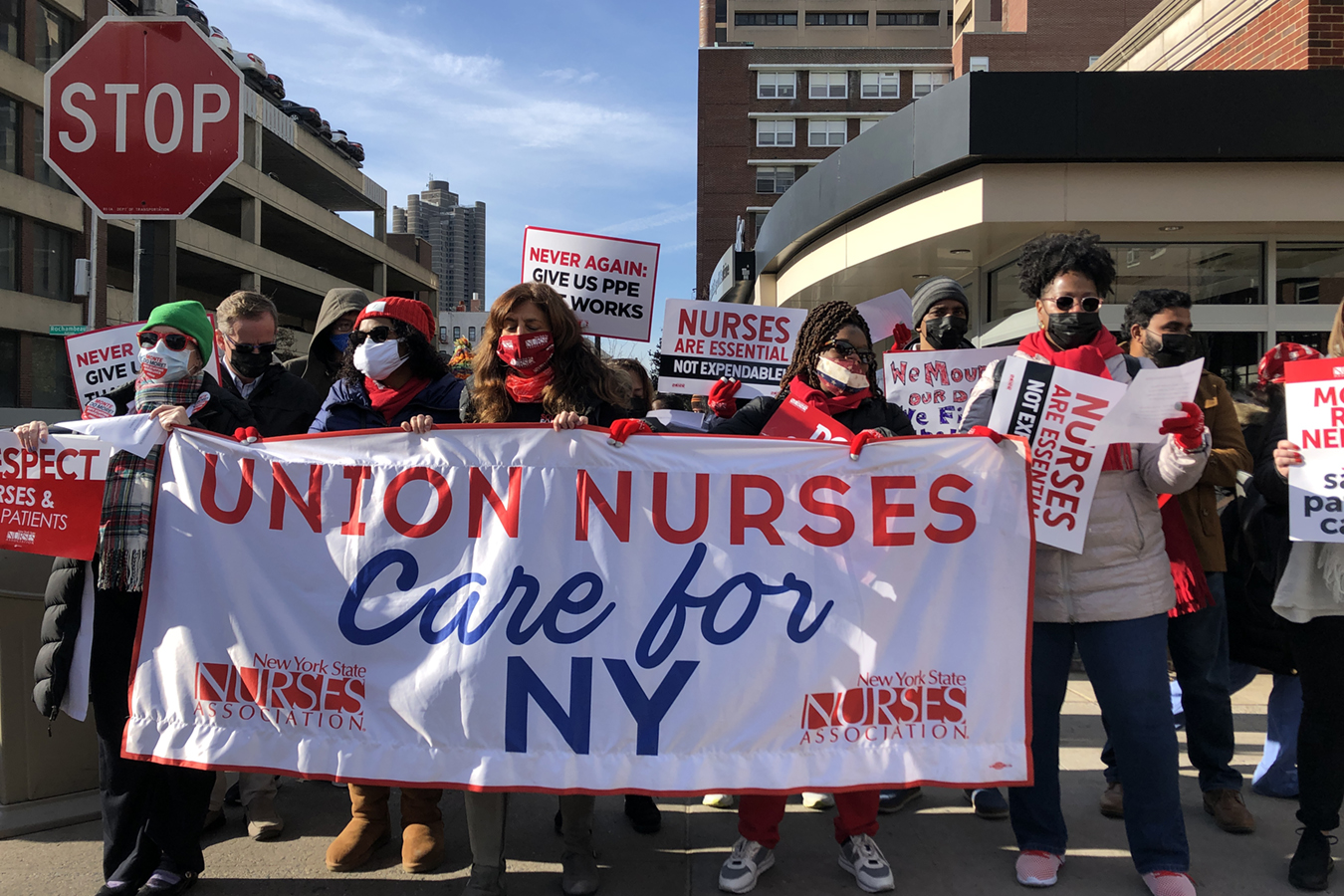
Nurses at Montefiore Medical Center, represented by the New York State Nurses Association, protest what they say is a personnel scarcity at numerous of the network’s health centers in the Bronx and neighboring residential areas on Nov. 19, 2020.( Fred Mogul/WNYC)
” Management is not living up to their guarantee to fill jobs and hire nurses,” stated Kristi Barnes, from NYSNA. “Since last week, they have 188 full-time nursing tasks they have actually not even posted, so there is no way they can be filled.”
The Montefiore administration disagrees.
” We have a contractual contract with the union, and we satisfy the contractual responsibilities of that agreement,” said Peter Semczuk, senior vice president of operations. “We customize our staffing in such a flexible way to satisfy the requirements of the client.”
Like many hospital systems, Montefiore relied greatly on momentary staffing agencies for “taking a trip nurses” from around the country previously this year Medical facilities are preparing to do so once again– but there is demand all over the nation
” They got us tourists in April, however that was 4 or 6 weeks in, and up until that we were on our own,” said Kathy Santoiemma, who’s been a nurse at Montefiore New Rochelle for 43 years. “I do not even know where they’re going to get travelers now– everyone around the whole country needs tourists.”
NYSNA led a two-day strike at Montifiore New Rochelle on Tuesday, after agreement settlements in the works for 2 years stalled on Monday.
Iavicoli said each of her network’s centers has submitted demands, so that New York City Health Hospitals could put a preliminary order now.
Health planners are hoping New Yorkers won’t flood into emergency clinic this time. They indicate the modest climb in COVID hospitalizations over the past two months compared with other areas, including New Jersey and Connecticut One thing they hope will keep the curve fairly flat is screening, which is more prevalent in New york city than practically anywhere else in the country About 200,000 individuals throughout New york city state are getting checked each day, roughly one-third of them in New York City.
” It’s the first step to in fact disrupting additional spread,” stated Dr. Dave Chokshi, the city health commissioner.
He said mass testing works on 2 levels– by highlighting which locations are hot zones, so health workers can target locals with “hyper-local” messages about COVID-19 spread, to get them to alter their behavior, and also by enabling contact tracers to interact individually with freshly infected people.
” As soon as someone tests favorable, we really quickly help them separate,” Chokshi said. “We do an interview with them to know who their close contacts are, and after that we call those contacts and ensure they’re quarantining too.”
The people it reaches say they’re staying put– however fewer than half of them share names of people they may have exposed.
“ During the summertime and early fall, when things were gradually increase, there were missed opportunities to utilize contact tracing to speak to 80 or 90%of all newly diagnosed individuals, to understand what their danger factors were and what examples … were they exposed to that could have possibly led to them getting the virus,” he stated. “You can never understand with 100?rtainty [where they contracted the virus], but if you ask these concerns, you could start to comprehend what some most likely patterns were– for example, of mass transit usage, or working in office buildings that didn’t have strenuous security procedures, or indoor dining.”
This knowledge, though imperfect, could lead to better informed public policy choices, Nash said, about whether to close indoor dining establishments, appeal salons or physical fitness. Without that data, leaders are simply making guesses.
Others fault the city’s testing and tracing program for not connecting enough to bad communities of color– which suffered disproportionately throughout the first COVID wave. Chokshi, the health commissioner, said getting screening sites to these areas has been a top priority– but a recent analysis recommended it’s not working along with the city meant.
” There’s clearly a variation in providing prevalent screening across New York City,” stated Wil Lieberman-Cribbin, a college student and environmental health researcher at Columbia University.
He looked at how many individuals are getting checked, by area, and associated those figures with race, income level and COVID positivity. In wealthier locations, individuals are getting much more tests and have much less disease. In poorer ones, people are getting numerous less tests and are much sicker. More testing in those locations would pick up cases faster, prior to individuals develop symptoms.
” Screening is really, truly required, not only to secure the most susceptible, but to collectively attempt and get a handle on COVID and resume New york city City,” Lieberman-Cribbin stated.
Individual protective equipment, or PPE, is likewise a lot more adequate than it was last spring but, similarly, remains a source of contention.
New york city state health authorities are needing healthcare facilities to stock a 90- day supply of PPE; for retirement home, it’s 60 days’ worth. Many facilities have complied with September and October due dates, however others have not
Montefiore, New York City Health Hospitals, and other large healthcare facility networks state they have at least that much, if not more.
They note that CDC guidelines permit “extended usage” of some PPE.
“[Nurses and other caregivers] alter their gloves between every client, however they might use the exact same N95 mask for one shift and put a surgical mask over it simply to preserve it and only change it out if there’s some integrity concern or it gets polluted,” stated Iavicoli, of the city medical facility system. “However definitely at the next shift, they’re getting a brand-new one.”
Iavicoli acknowledged the obstacles as the pandemic rolls on and stated there are four sort of days: “blue skies, or typical,” “busier than typical,” “a little extended” and “exceptionally stretched.”
” I believe we’re at the top end of ‘hectic regular’ verging on ‘a little bit more than overstretched,'” stated Iavicoli.
This story is from a reporting partnership that includes WNYC, NPR and KHN
Related Topics
Health Market Public Health States
COVID-19 New York City Nurses
Find Out More
http://cnacertificationprogram.net/new-york-city-healthcare-facility-employees-understanding-how-bad-it-can-get-brace-for-covid-2nd-wave/
Comments
Post a Comment